Multiple Sequence Alignment (MSA) Tool — Free Online (2026)
Align DNA, RNA, or protein sequences to find conserved regions, spot paralogs, and build phylogenetic trees. Powered by MAFFT. No command line needed.
Sequence Input
Alignment Method
Parameters
▸
Alignment Viewer
VigyanLLM's multiple sequence alignment tool uses Clustal Omega for accurate alignment of DNA, RNA, or protein sequences. The MSA engine outputs a consensus sequence, phylogenetic tree, and position-specific scoring matrices for downstream analysis.
| Input | Output |
|---|---|
| FASTA sequences | Aligned sequences with gap placement |
| Clustal/Nexus format | Consensus sequence & conservation scores |
| Distance matrix | Phylogenetic tree (Newick format) |
| Guide tree | PSSM for motif discovery |
Quick Answer: Your Alignment Is Only as Good as Your Sequence Set
A multiple sequence alignment exposes conserved cores, tolerated substitutions, and indels — but only if every sequence in the input actually belongs in the alignment. The most common silent failure we see is a paralog sneaking into an ortholog set: it looks like your gene, aligns passably, and quietly corrupts your conserved regions, downstream motifs, and any primers you design from them. BLAST often cannot catch this, because it scores the best local hit without telling you that the “best hit” is a related family member. The worked example below shows how an alignment makes the trap obvious.
A good MSA also tells you things a single sequence never can: which residues are functionally untouchable (they are identical everywhere), where the protein tolerates drift (columns that swap freely), and where insertions or deletions actually happened in evolution rather than being an error in one record. That context is what turns a stack of FASTA records into a biological statement — and it is the reason alignment quality matters as much as the sequences themselves.
TP53 Across Five Species: A Worked Alignment
Consider the human tumour suppressor TP53 aligned against its orthologs from mouse, chicken, and zebrafish — the standard cross-species design exercise for conserved primers. The five sequences are the human, hamster, mouse, rat, and zebrafish orthologs of TP53, trimmed to the coding region and translated, then aligned by Clustal Omega with defaults.
| Insight | What the alignment shows |
|---|---|
| Conserved DNA-binding domain | Exons 4–8 align tightly across all species — this is TP53’s functional core |
| Disordered N-terminus | The first ~50–80 residues barely align — normal for a transactivation domain |
| Paralog trap | Accidentally include TP63 and exons 4–8 still align (~65% identity) — but exon 10 diverges, exposing the mistake |
The trick is in what happens outside the core. The DNA-binding domain of a true TP53 ortholog lines up tightly with every other true ortholog. The pseudogene, by contrast, drifts immediately after the conserved core — it carries frameshifts and premature stops that break the alignment into a screen of gaps and mismatches.
There is a second, sneakier version of the same trap: the processed pseudogene. TP53 has a known retrocopy on chromosome 17 — a real, transcribed-looking sequence that a lab can accidentally amplify or download instead of the genuine locus. A pseudogene aligns beautifully through the DNA-binding core, because it was copied from that exact mRNA, then falls apart afterwards as frameshifts and premature stops shred the alignment.
This is precisely the case where single-sequence BLAST lets you down. BLAST reports the best local hit, which a pseudogene readily provides, and it will happily mark it “TP53”. Only the alignment — with every column on the page — shows that the tail of the molecule does not belong.
Why Your Alignment Looks Wrong
Before you mistrust the tool, check the input. These five symptoms almost always trace to a sequence-mixing problem you can see and fix in a minute:
| Symptom | Cause | Fix |
|---|---|---|
| Gaps everywhere, alignment looks shredded | Sequences too divergent (nucleotides beyond ~40% identity) | Align the proteins (back-translate); use a more conserved region |
| One sequence has a massive insertion | Misidentified exon or contamination | BLAST the suspicious sequence separately |
| Conserved columns don’t match the known domain | Wrong reading frame or wrong strand | Confirm all sequences share one orientation (5′→3′) |
| MUSCLE differs from Clustal Omega | Ambiguous alignment region | Both are valid; check which matches known domain boundaries |
| Alignment mostly gaps at the ends | Sequences have different (truncated) lengths | Trim to the shared region; design primers in the conserved core |
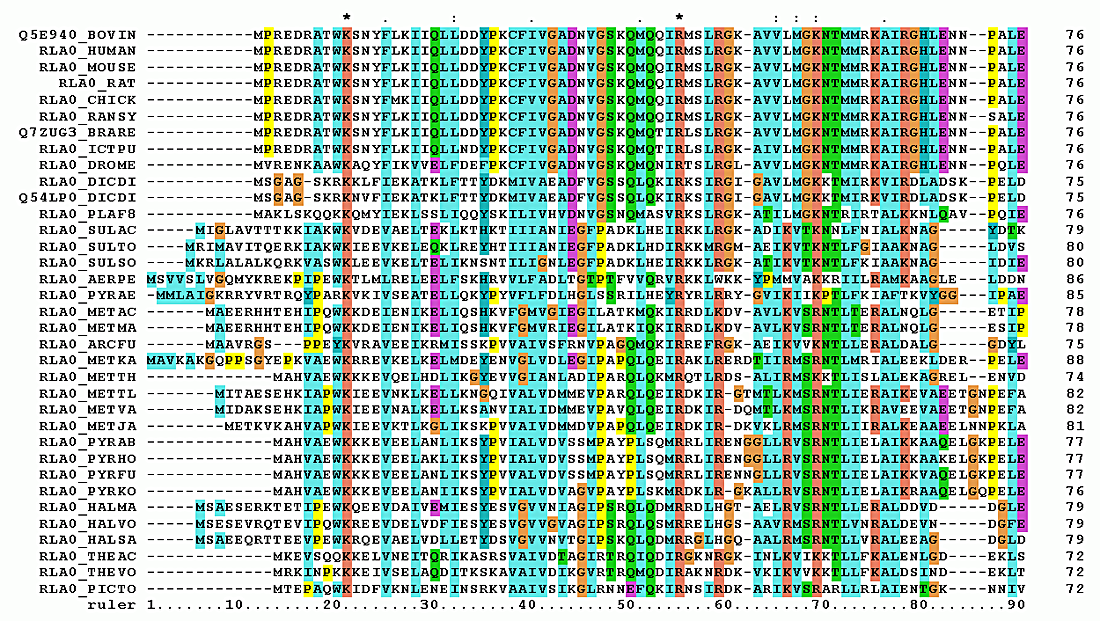
Reading the conservation track is the fast diagnostic. Every column carries a percentage: the fraction of sequences agreeing at that position. A genuinely conserved domain shows long runs near 100%, interrupted only by tolerated wobble positions; a junk or paralog region shows columns scattered from 100% down to noise, with gaps that never resolve.
Why Multiple Sequence Alignment Matters
Multiple Sequence Alignment (MSA) is fundamental to comparative genomics, phylogenetics, and protein structure prediction. By aligning three or more sequences, MSA reveals conserved regions (evolutionarily important functional domains), variable regions (sites under positive selection), and gap patterns (insertions/deletions in evolutionary lineages). MSA is the prerequisite step for phylogenetic tree construction, conserved motif discovery, primer design for conserved gene regions, and predicting the functional impact of sequence variants.
MSA Algorithms: Choosing the Right Tool
| Algorithm | Best For | Speed | Accuracy |
|---|---|---|---|
| Clustal Omega | Large datasets (up to 190K seqs), protein alignments | Very fast | High |
| MUSCLE | Medium datasets, highest accuracy for small sets | Fast | Very high |
| MAFFT | Large genomes, RNA alignments with secondary structure | Fast | High |
| T-Coffee | Small datasets requiring maximum accuracy | Slow | Highest |
This tool exposes three of them because the choice depends on your data. Clustal Omega balances speed and accuracy and is our recommended default for most primer-design tasks. For large-scale genomic comparisons, MAFFT offers faster performance on very big alignments. For critical structural alignments where maximum accuracy matters, T-Coffee can incorporate structural information into the alignment.
How to Prepare Sequences for Meaningful MSA Results
Clean input data produces cleaner alignments: (1) ensure all sequences are oriented in the same direction (5' to 3' for DNA/RNA), (2) trim low-quality bases or vector sequences before alignment, (3) use homologous regions of similar length — including long non-homologous flanks reduces alignment quality, (4) for protein MSAs, verify you are using the correct reading frame, and (5) consider the expected evolutionary distance — highly divergent sequences may require more sensitive alignment parameters. For primer design targeting conserved regions, align orthologous sequences from 3-5 related species to identify >95% conserved stretches of 18-24 nucleotides.
For cross-species primer design specifically, a three-step habit catches most problems before they cost you a plate: (1) align orthologs from three to five species and mark the columns that are 100% conserved across all of them; (2) check that those conserved columns sit inside the domain you care about (for TP53, exons 4–8) rather than in a rapidly drifting tail; and (3) scan the region 18–24 nucleotides around your candidate primer for any column where even one sequence carries a mismatch or gap — because a single 3' mismatch at the wrong position can silence the primer in that species.
Frequently Asked Questions About Multiple Sequence Alignment
Clustal Omega vs MUSCLE vs MAFFT — which should I use?
Clustal Omega is the fast, general-purpose default and our recommended starting point for most primer-design tasks. MUSCLE tends to behave better on more divergent sequence sets, while MAFFT is the most accurate choice for large alignments and for RNA or genomes. There is no single best; pick by your data size and how divergent the sequences are.
How many sequences can I align?
For a typical primer-design or domain study, ten to a few hundred sequences is comfortable and fast. If you need tens of thousands, Clustal Omega and MAFFT scale further, though very large alignments get harder to read for the conservation question most users actually care about.
Why does my nucleotide alignment look worse than my protein alignment?
Nucleotides form a 4-letter alphabet, so sequence divergence saturates quickly and past roughly 40% identity the alignment shreds. Proteins, with a 20-letter alphabet, stay informative over much longer evolutionary distance. If your coding sequences diverge too far to align by nucleotide, back-translate and align the protein instead.
Can I use this for primer design across species?
Yes — that is one of the best uses of an MSA. Align orthologs from several related species, find the stretches that are completely conserved (often in an exon whose product is functionally constrained), and design primers there. The conserved core also warns you off designing across the paralog trap described above.
What format should my input sequences be in?
Plain FASTA. Put a header line starting with '>' before each sequence, one line of bare sequence per entry is enough, and paste or upload a .fa, .fasta, .fna, or .txt file. All sequences must be in the same orientation and use the same alphabet (DNA vs protein).
How do I interpret a conservation score?
The conservation track shows, for each alignment column, how many sequences agree at that position. High columns (toward 100%) are the functionally constrained core; low columns are tolerated drift or ends. When you are designing primers, target high-conservation columns inside the shared core and avoid columns that are gappy in even one sequence.