Automated Primer Design — How It Works, Step by Step
Design validated primer pairs and TaqMan probes in under 30 seconds. VigyanLLM Primer runs a 24-step validation pipeline — thermodynamics, BLAST specificity, SNP screening, and repeat masking — and outputs validated results with no software installation.
Design Primers Free →No signup required for your first 5 designs. Runs in your browser.
How VigyanLLM Compares to Other Primer Design Tools
We benchmarked VigyanLLM against Primer3, Primer-BLAST, and commercial alternatives across the features researchers actually use.
| Feature | VigyanLLM | Primer3 | Primer-BLAST | IDT OligoAnalyzer |
|---|---|---|---|---|
| Thermodynamic Tm (SantaLucia 1998) | ✓ Nearest-neighbour | ✓ Basic | ✗ Primer3 only | ✓ |
| BLAST specificity check | ✓ Automated | ✗ Manual step | ✓ Integrated | ✗ Separate tool |
| Hairpin & dimer ΔG prediction | ✓ Full pipeline | ⚠ Limited | ✗ Not included | ✓ |
| SNP & repeat masking | ✓ dbSNP + RepeatMasker | ✗ | ✗ | ✗ |
| TaqMan probe design | ✓ Auto-generates | ✗ | ✗ | ✓ Separate tool |
| Multiplex PCR scoring | ✓ 2–6 plex | ✗ | ✗ | ✗ |
| PDF audit reports | ✓ | ✗ | ✗ | ✓ Order form only |
| IDT/Twist vendor export | ✓ CSV | ✗ | ✗ | ✓ Native |
| Price | Free (5/day) | Free (local) | Free (web) | ⚠ Requires purchase |
What Is Automated Primer Design?
Automated primer design replaces manual trial-and-error with algorithmic selection and multi-parameter validation.
Thermodynamic Profiling
Every candidate primer is scored using SantaLucia 1998 nearest-neighbour thermodynamics. The tool calculates melting temperature (Tm), predicts hairpin loops and self-dimer formation, and estimates free energy (ΔG) for secondary structures. Primers that form stable secondary structures (ΔG < -2 kcal/mol) are flagged or rejected.
BLAST Specificity Screening
Designed primers are automatically BLASTed against NCBI refseq databases to verify that they amplify only the intended target. Off-target hits with fewer than 3 mismatches in the last 5 nucleotides of the 3' end are flagged. You can set taxonomy filters to restrict hits to your organism of interest.
SNP & Repeat Masking
Primers overlapping known single-nucleotide polymorphisms (dbSNP, COSMIC) or repetitive elements (RepeatMasker, simple repeats, low-complexity regions) are penalized or excluded. This reduces amplification failure rates caused by genetic variation across individuals.
GC Content & Length Optimization
GC content is constrained to 40–60% to prevent primers from being too stable (high GC) or too unstable (low GC). Primer length defaults to 18–25 nucleotides, balancing specificity against synthesis cost. A 3' GC clamp (G or C at the last two positions) improves polymerase binding.
Amplicon Size Control
The tool enforces a user-defined amplicon size range (default 100–300 bp for qPCR, 200–1000 bp for standard PCR). This ensures compatibility with downstream applications — shorter amplicons for quantitative PCR, longer for cloning or sequencing.
QPCR Probe Design
For qPCR applications, the tool automatically designs a TaqMan hydrolysis probe between the forward and reverse primers. The probe Tm is targeted 5–10°C above the primer Tm, and dye-quencher compatibility is validated (FAM/BHQ1, VIC/BHQ2, etc.). Probe secondary structure is checked independently.
Understanding PCR Primer Design Parameters
The key parameters that determine whether a primer pair will work in the lab.
Melting temperature (Tm) is the most critical parameter. It determines the annealing temperature during PCR cycling. The SantaLucia 1998 nearest-neighbour model calculates Tm by summing enthalpy (ΔH) and entropy (ΔS) contributions from each nearest-neighbour dinucleotide pair, then applying a salt correction. The formula is: Tm = ΔH / (ΔS + R × ln(Ct/4)) - 273.15, where R is the gas constant and Ct is the total strand concentration. This is more accurate than the basic Wallace rule (2°C × (A+T) + 4°C × (G+C)) because it accounts for stacking interactions between adjacent bases.
GC content directly affects Tm and secondary structure. A primer with 50% GC has roughly equal A-T and G-C pairs. Higher GC content increases Tm and the likelihood of forming stable hairpins. Lower GC content reduces Tm and may produce weak or non-specific amplification. The optimal range (40–60%) represents a practical compromise that works across most genomic targets.
Secondary structure includes hairpins (intramolecular folding) and dimers (intermolecular binding between forward and reverse primers). Self-dimers form when a primer anneals to itself, creating primer dimers that consume reagents and produce artifacts. Cross-dimers form between the forward and reverse primers. Both are scored by free energy (ΔG): values more negative than -2 kcal/mol indicate stable structures that are likely to cause problems.
3' specificity is determined by the last 5–7 nucleotides of the primer. Even a single mismatch in this region can reduce polymerase extension efficiency. BLAST checks whether the 3' end of your primer has perfect or near-perfect matches elsewhere in the genome. Primers with off-target 3' matches are flagged because they may amplify unintended products.
Amplicon size affects both the efficiency and application of PCR. Smaller amplicons (100–200 bp) amplify more efficiently and are preferred for qPCR. Larger amplicons (500–2000 bp) are needed for cloning and sequencing but require longer extension times and may fail with degraded templates. The tool enforces your chosen range to ensure the output matches your experimental needs.
Step-by-Step: How to Design Primers Online
From sequence input to validated primer pairs in under 30 seconds.
Paste Your Target Sequence
Enter a DNA sequence in FASTA format or as a plain nucleotide string. You can paste a gene accession, a cloned region, or a synthetic sequence. The tool accepts sequences from 50 to 10,000 nucleotides.
Configure Parameters
Set your preferred Tm range (default 58–65°C), GC content bounds, amplicon size, and reaction conditions (Na⁺, Mg²⁺, dNTP concentrations). Defaults work well for most standard PCR applications.
Run the 24-Step Pipeline
Click "Design Primers" and the pipeline runs: candidate generation, thermodynamic filtering, BLAST specificity screening, SNP overlap check, repeat masking, secondary structure analysis, and final scoring. Most designs complete in 15–30 seconds.
Review & Export
Each primer pair is presented as a card showing Tm, GC%, length, hairpin ΔG, self-dimer ΔG, and a quality score. Expand any pair to see the full validation report. Export to PDF for lab records or CSV for IDT/Twist ordering.
Common Primer Design Mistakes
Avoid these pitfalls that cause PCR failure or non-specific amplification.
| Mistake | Why It Fails | How VigyanLLM Prevents It |
|---|---|---|
| Tm difference >5°C between primers | One primer anneals while the other doesn't, causing asymmetric amplification | Pipeline rejects pairs with ΔTm >3°C by default |
| Primers with homopolymer runs (AAAA, GGGG) | Polymerase slippage causes indel artifacts | Homopolymer filter rejects runs of 4+ identical bases |
| Ignoring SNP overlap | Primer binds one allele but not the other, causing allele dropout | dbSNP/COSMIC overlap check flags or excludes overlapping primers |
| No 3' GC clamp | Weak polymerase binding at the 3' end reduces extension efficiency | GC clamp filter ensures G or C in the last 2 positions |
| Primer dimers below -2 kcal/mol | Self-dimers form during cycling, consuming primers and producing artifacts | ΔG threshold filter rejects primers with stable dimer potential |
| Amplifying non-specific targets | BLAST shows off-target binding but the primer was used anyway | BLAST specificity check with configurable mismatch thresholds |
Frequently Asked Questions
What is the best free primer design tool in 2026?
VigyanLLM Primer is a free online primer design tool that runs a 24-step validation pipeline including Primer3 thermodynamics, BLAST specificity checking, SNP screening, and repeat masking. It produces validated primer pairs with no software installation required. The first 5 designs per day are completely free.
How does automated primer design work?
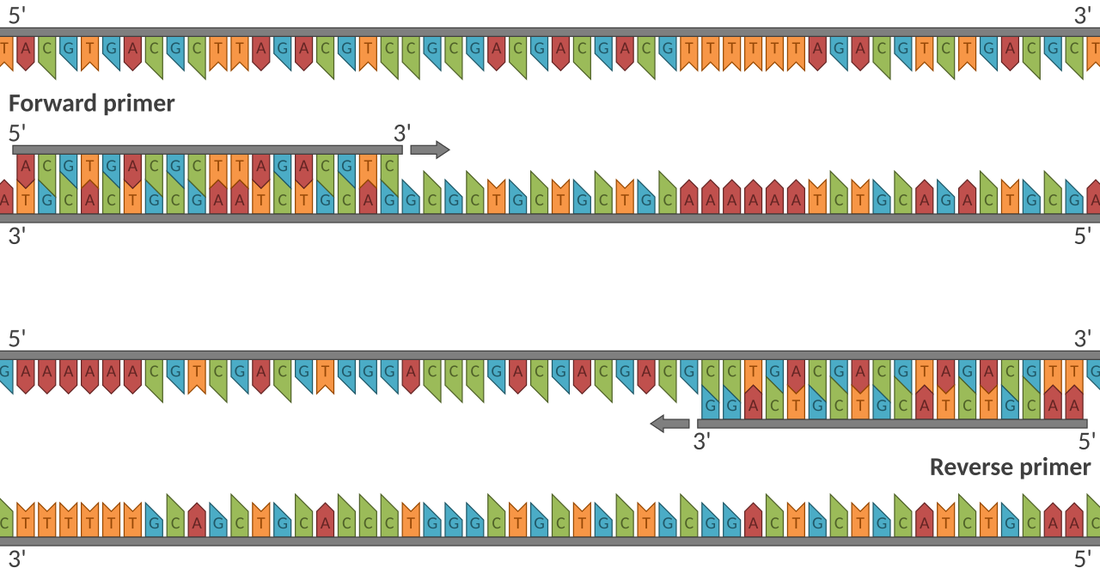
Automated primer design uses algorithms to select forward and reverse primer sequences based on thermodynamic constraints (melting temperature, GC content, secondary structure), then validates specificity against NCBI databases using BLAST. VigyanLLM combines Primer3 core engine with SantaLucia 1998 nearest-neighbour parameters to calculate Tm and predict hairpin/dimer formation, then runs BLAST to confirm target specificity.
What primer design parameters does the tool optimize?
The tool optimizes melting temperature (target 58–65°C), GC content (40–60%), primer length (18–25 nt), 3' GC clamp, hairpin free energy (ΔG > -2 kcal/mol), self-dimer ΔG, cross-dimer ΔG, amplicon size, and BLAST specificity. Each parameter has configurable thresholds and the pipeline rejects primers that fail any check.
Can I design qPCR primers and TaqMan probes?
Yes. The tool supports standard PCR, qPCR, multiplex, degenerate, bisulfite, and allele-specific primer design. For qPCR, it also designs dual-labelled TaqMan hydrolysis probes with Tm differential optimization (probe Tm 5–10°C above primer Tm), dye-quencher compatibility checks, and secondary structure validation.
Is VigyanLLM primer design accurate?
VigyanLLM uses the same thermodynamic models as NCBI Primer-BLAST (SantaLucia 1998 nearest-neighbor parameters) and Primer3 core engine. The validation page shows head-to-head comparisons against published primer sets including SARS-CoV-2 N1, human GAPDH, and human ACTB, with Tm values agreeing within tool-to-tool variation.
Do I need to install any software?
No. VigyanLLM runs entirely in your web browser with computation on our servers. There is nothing to install, configure, or update. You paste a DNA sequence, configure your parameters, and get results in under 30 seconds.
How is this different from NCBI Primer-BLAST?
NCBI Primer-BLAST designs primers and checks specificity but does not validate thermodynamic properties like hairpin or dimer formation. VigyanLLM adds SNP screening, repeat masking, TaqMan probe design, multiplex scoring, and generates fully documented PDF reports. It uses the same Primer3 backend for core design but extends the validation pipeline significantly.
Last updated: September 2026 · Reviewed by VigyanLLM Research Team